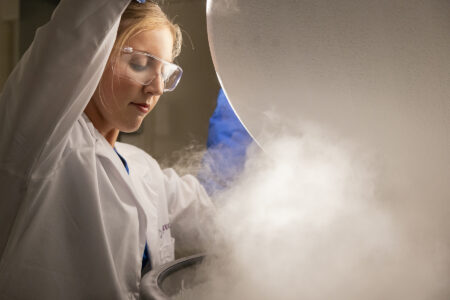


As egg freezing and IVF become more common, patients are asking important questions about where their frozen eggs and embryos are stored, how they are protected, and what happens to them over time.
Presented by Reprotech
Imagine it’s the year 2100. Hundreds of millions of people were born thanks to the help of cutting-edge cryopreservation technology, according to RBMO Journal. Due to medical advances in the field, almost all of these births were associated with embryos and eggs that were once frozen and stored in a lab.
This is the future of fertility. Anyone can embrace the option to build a family. How did we get here?
IVF: Then and Now
Today, despite astonishing growth in this fertility option, cryo-management practices in IVF have barely evolved since IVF was founded nearly half a century ago. Clinics have had to rely on manual systems borrowed from when frozen fertility cells were originally used to breed livestock!
This labor-intensive process includes labeling specimens by hand, measuring liquid nitrogen levels in tanks with yardsticks and dipsticks without the benefit of reliable electronic sensors, and tracking patient data often using paper logs. As any physician or lab technician will tell you, these tasks are time-consuming and ultimately leaves room for human error.
Egg and embryo freezing has grown exponentially over the last two decades. This boom has left a cumulative total of well over 1,000,000 eggs and embryos currently preserved in fertility clinic laboratories. And yet, there are still too many news headlines about embryo mix-ups and devastating losses. This labor-intensive process includes labeling specimens by hand, measuring liquid nitrogen levels in tanks with yardsticks and dipsticks without the benefit of reliable electronic sensors, and tracking patient data often using paper logs. As any physician or lab technician will tell you, these tasks are time-consuming and ultimately leaves room for human error.
In today’s medicine, almost all IVF cycles use eggs, sperm, and embryos that were once frozen, and often stored for long periods of time.
Every year, more families are being created through IVF and cryopreservation—the process of cooling and storing cells, tissues, or organs at cryogenic temperatures to save them for future use. With this method, eggs are flash-frozen by immersing them in liquid nitrogen, cooling them nearly instantly to -196 C, so they become glass-like, or vitrified. This quick-freezing process nearly eliminates the possibility of ice crystals forming inside the eggs and damaging them.
As our world rapidly shifts towards cryopreservation, on any given day, IVF clinics globally are actively managing and storing millions of frozen fertility cells, helping create families of all kinds around the world. This notable rise in IVF and egg freezing can be attributed to a host of factors ranging from an increase of family planning options and access, the use of IVF for family-building by LGBTQ+ communities, and parents planning to create their families later in life.
Freezing eggs or undergoing IVF can be an immensely expensive, labor-intensive, and emotional process for patients. Every year, more families are being created through IVF and cryopreservation—the process of cooling and storing cells, tissues, or organs at cryogenic temperatures to save them for future use.
As more people build their future family plans around frozen sperm, eggs and embryos, long-term storage has to be built for continuity and increased transparency.
According to Cynthia Hudson, VP of Clinical Strategy at Reprotech, “For patients, the importance of their frozen eggs and embryos doesn’t fade once they’re in storage – it endures. Long-term cryostorage must be built for that reality.”
Reprotech is responding to the need for a new standard of care for frozen eggs and embryos used in IVF with TMRW’s next-generation digital specimen management and automated storage platform. The model is designed to support safe handling, clear tracking, and reliable oversight from storage through transport and back again—and that work continues to advance through ongoing innovation in monitoring and traceability. Across its cryostorage network, 700K+ specimens are safeguarded in seven dedicated biorepositories supported by 24/7 monitoring, real-time alerts, and systems built to strengthen oversight. As our world rapidly shifts towards cryopreservation, on any given day, IVF clinics globally are actively managing and storing millions of frozen fertility cells, helping create families of all kinds around the world.
As a result, potential points of failure that may happen through manual systems (and responsible for some of the disturbing headlines we’ve seen about embryo mix ups), are greatly reduced – delivering peace of mind for people who care deeply about their frozen specimens. “As more patients rely on frozen eggs and embryos over longer periods of time, the systems supporting long-term storage have to keep evolving too — with stronger tracking, safer handling, and clearer visibility into what happens along the way,” said Mark Swift, Chief Technology Officer at Reprotech.
As frozen specimen volumes continue to grow, Reprotech’s long-term cryostorage model reflects where the field is heading: toward more connected systems, stronger visibility, and infrastructure designed to support safe storage at scale.
Fertility of Tomorrow
So much is changing in the world of fertility, and more than just technology. Culturally, conversations around fertility have increased as younger generations gain greater access to information and resources, empowering them with options as they consider family planning.
Companies and nonprofits have been successful in providing communities with the information and power to learn about fertility possibilities. More celebrities and people in powerful positions are publicly discussing their lived experiences of assisted reproductive technology and modern family planning. This amplifies and normalizes the conversation on multiple levels, bringing these important, emotional experiences to dinner table conversations, internet exchanges, podcasts, media, television, and more. Today, intended parents can access support groups, join online forums, see representation in media, and even attend conferences to share resources and feel solidarity with others TTC with the help of assisted reproductive technology.
It’s an exciting, evolving world, and this cultural shift is in part thanks to technological advances, like those offered by Reprotech, aiming to ensure that the process of creating a family is as safe as possible.
“Technology is crucial for the future of fertility, especially in an industry with such a rapid growth trajectory. We are redefining the standard for specimen management and storage in reproductive health,” said Louis Villalba, Chief Executive Officer at Reprotech.
Family building looks different for everyone. Whether preserving fertility for the future, preparing for medical treatment, pursuing parenthood independently, or growing a family through IVF and donor conception, more people than ever have access to options that can help make parenthood possible.
As fertility preservation and assisted reproductive technology continue to evolve, so too will the systems that support them. Greater transparency, innovation, and confidence in long-term specimen storage can help patients feel informed and supported throughout every stage of their journey—ensuring that the possibilities created today can help build the families of tomorrow.

This article is presented by Reprotech, a trusted partner for secure, long-term cryostorage, supporting 300+ fertility clinics with more than 35 years of proven expertise. Find out more about their solutions, and more accessible pricing plans, by visiting https://reprotech.com/for-customers/customers-overview/.

Listen to stories, share your own, and get feedback from the community.