





The Elusive Science of Egg Quality
In the nearly five decades since the birth of In Vitro Fertilization (IVF), the field has transformed from experimental science into a cornerstone of modern family building around the world. What began in 1978 with the first successful IVF birth has evolved into a global practice that has helped millions of people conceive.
Along the way, advancements in lab technology, hormone protocols, and embryo culture have steadily improved success rates. But even as IVF has become more sophisticated, one factor has remained both central and frustratingly difficult to define: egg quality. Even as IVF has become more sophisticated, one factor has remained both central and frustratingly difficult to define: egg quality.
For decades, egg quality has traditionally been estimated using patient age, and what embryologists observe under a microscope – shape, size, and visible structural features. While this approach has guided clinical decision-making, it has also left significant room for uncertainty.
After an egg retrieval procedure, patients are often told how many eggs were retrieved, but not necessarily how viable those eggs truly are. This gap between quantity and quality has long shaped the IVF experience, underscoring a core challenge in reproductive medicine: some of the most important signals of reproductive potential have historically been the hardest to measure, leaving both patients and clinicians with a lot of unknowns.
Today, however, a new wave of innovation is beginning to change that, offering the potential to move from educated guesswork toward deeper, data-driven insight into egg quality and what it truly means for the future of fertility.
Why Egg Quality Matters
Egg quality is one of the most important, yet often least understood, factors in reproductive success.
At its core, egg quality refers to an egg’s ability to be fertilized, develop into a healthy embryo, and ultimately result in a viable pregnancy. Egg quality influences everything from fertilization rates to embryo development and implantation, making it a critical driver at every stage of the IVF process. For patients, this often translates into uncertainty: why one cycle works and another doesn’t, or why ‘good numbers’ don’t always lead to success. Understanding and better assessing egg quality is not just a scientific challenge; it’s central to improving outcomes, reducing emotional and financial strain, and giving patients clearer, more actionable insight into their fertility journey.
What makes egg quality especially complex is that it cannot be directly measured in a simple or definitive way. For the majority of patients, there is no way to know if their eggs are ‘any good’ until embryologists attempt to fertilize them.
Age remains the most widely recognized proxy, as egg quality tends to decline over time (and most notably, after 35 years old), as well as number (quantity) of eggs retrieved, but it’s far from the whole story. Genetics, environmental factors, and underlying health conditions can all play a role, and variability exists from cycle to cycle.
For patients, this often translates into uncertainty: why one cycle works and another doesn’t, or why ‘good numbers’ don’t always lead to success. Understanding and better assessing egg quality is not just a scientific challenge; it’s central to improving outcomes, reducing emotional and financial strain, and giving patients clearer, more actionable insight into their fertility journey.
Ash’s Story: Quantity Does Not Equal Quality
This pain point is felt by many in our audience, and pregnantish community member Ash shared her story with us:
“I’m 38, and for the past three years, my life has quietly revolved around trying to get pregnant. On paper, everything has looked promising, including during IVF. Even though I’m a bit scared of needles, I was surprised that my body actually responded well to stimulation. I’ve done three cycles so far, and each time I have produced a high number of eggs, especially for my age, and each cycle begins with this cautious optimism. But then, somehow, it always unravels.
The fertilization rates aren’t what we expect, or the embryos don’t develop the way they should. During every cycle, I’ve been told my eggs aren’t healthy enough to properly fertilize. I’ve never even made it to the point of implantation. Each time, I’m left staring at numbers that seemed encouraging at the start, trying to understand where things went wrong. It’s really frustrating. I keep feeling like my body is failing at the one thing it should know how to do. Logically I know that’s not true, but emotionally it’s hard to not take on the blame. The fertilization rates aren’t what we expect, or the embryos don’t develop the way they should. During every cycle, I’ve been told my eggs aren’t healthy enough to properly fertilize. I’ve never even made it to the point of implantation.
What’s been hardest is the not knowing. After advocating for ourselves at the clinic, my husband’s sperm was tested extensively, and everything looks great. So naturally, we’re left wondering about my eggs, but no one can really tell me about the quality with any certainty.
I keep hearing about my age, about projected statistics based on people my age, about what’s ‘typical,’ but none of it feels specific to me and it’s honestly a bit crazy-making. I wish I had more insight into what’s actually happening with my eggs, because it’ll help me understand my options and whether or not I want to keep going forward with retrievals.
Right now, it feels like I’m going through this physically, emotionally, and financially exhausting process without a clear understanding of why it’s not working, or what I can do differently next time. It’s hard to hold onto hope without clear information or answers.”
Enter: AI-Powered Egg Quality Insights with Future Fertility
The company at the forefront of re-examining egg quality is Future Fertility, whose product MAGENTA™ is designed specifically for IVF patients seeking more clarity around egg quality.

Future Fertility is a Toronto-based health technology company helping fertility patients and their care teams better understand egg quality during IVF and egg freezing. Using AI to analyze microscope images of oocytes (eggs), its tools go beyond age-based assumptions to provide personalized insights – supporting conversations about treatment planning and what to expect. Future Fertility’s technology is developed using one of the world’s largest databases of oocyte images and associated reproductive outcomes, and is used by more than 300 fertility clinics in 35+ countries.
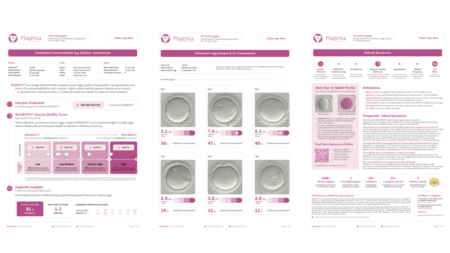
Unlike traditional approaches that rely on age-based statistics or visual grading, MAGENTA™ uses artificial intelligence to analyze images of a patient’s eggs and generate personalized egg quality scores that are directly correlated with each egg’s likelihood of developing into a high-quality embryo. These scores are not abstract, and they offer a more personalized and data-driven understanding of reproductive potential. While it doesn’t guarantee success, MAGENTA™ offers something that has long been missing in IVF: clearer, personalized insight into one of the most important variables in the journey.
At its core, MAGENTA™ represents a shift from population-based assumptions to customized insight. By training its AI on hundreds of thousands of egg images and their real-world outcomes, Future Fertility’s technology can detect subtle patterns invisible to the human eye, helping identify which eggs are more likely to progress to the critical blastocyst stage.
Fertility specialists like Dr. Drew V. Tortoriello, M.D. Medical Director at Sher Fertility Solutions – New York, utilize Future Fertility tools in their practice:
“Future Fertiity’s technology has helped some of our patients determine the number of egg retrievals they’ve wanted to pursue. It gives them a better understanding of their reproductive potential and in a non invasive way, gives them more insight.”
For patients and clinicians, this means moving toward more informed decision-making: understanding whether outcomes are driven by egg quality, adjusting treatment strategies, and planning future cycles with greater precision. While it doesn’t guarantee success, MAGENTA™ offers something that has long been missing in IVF: clearer, personalized insight into one of the most important variables in the journey.
Inside the Innovation: Spotlight on Co-Founder, Dr. Dan Nayot
To better understand the thinking behind this innovative technology, we spoke with Dr. Dan Nayot, Co-Founder and Chief Medical Officer of Future Fertility. With a background in reproductive endocrinology and a deep focus on improving IVF outcomes, Dr. Nayot shares how MAGENTA™ is bringing new clarity to one of fertility’s most complex questions.
“As a fertility specialist, one of the most common questions I hear is: ‘how is my egg quality?’ Historically, we haven’t had a clear way to answer. We can measure egg quantity with ultrasound (AFC) and bloodwork (AMH), but not egg quality—so we rely on age as a proxy.
This is a fundamental clinical gap. The egg is the most central component of IVF, yet it is the one element we cannot objectively measure.
Even after retrieval and examination under a microscope, egg quality cannot be reliably assessed — no validated scoring system exists. In practice, clinicians infer quality from age and outcomes, often attempting to attribute results to the egg, sperm, or laboratory conditions without any real certainty. When we retrieve a group of eggs, MAGENTA™ helps us understand that not all eggs have the same developmental potential. That’s something we’ve always known conceptually, but now we can start to measure and quantify it.
Training in mathematics and applied statistics, alongside an interest in AI, shaped how I approached this problem. AI is uniquely positioned to help here — it can extract meaningful signals from complex visual data and identify patterns beyond what the human eye can detect. That’s what motivated us to leverage AI to develop what we think of as ‘egg scoring 2.0.’ MAGENTA™ is an AI-powered tool that analyzes images of individual mature eggs and provides an objective score associated with their likelihood of developing into blastocysts. When we retrieve a group of eggs, MAGENTA™ helps us understand that not all eggs have the same developmental potential. That’s something we’ve always known conceptually, but now we can start to measure and quantify it.
One of the most important things I wish patients understood is that egg quality is not uniform — even within the same cycle. We often talk about age as a proxy for egg quality, but age is really just a population-based estimate. It doesn’t tell you how your specific eggs will perform.
This is part of why IVF can feel unpredictable. Averages help set expectations, but they don’t tell us what will happen for any one individual. Tools like this help bring more clarity to that variability. They don’t eliminate uncertainty, but they do help explain it. Ultimately, this is about replacing assumptions with data — bringing more certainty to a process that is already emotionally and clinically complex.”
Ultimately, this is about replacing assumptions with data — bringing more certainty to a process that is already emotionally and clinically complex.”
From Guesswork to Guidance
For patients like Ash, and so many others navigating IVF, the hardest part is often not just the outcome – it’s the uncertainty along the way. The gap between what can be measured and what truly matters has long shaped the fertility experience, leaving patients to make deeply personal decisions without clear, individualized insight.
But as technology begins to catch up to these unanswered questions, that experience is starting to shift. Tools like MAGENTA™ don’t promise guarantees, but they do offer something profoundly meaningful: a clearer understanding of what’s happening at the most fundamental level.
As technology continues to evolve, fertility care is moving toward a more personalized, data-driven future – one where patients are no longer relying solely on averages or assumptions, but on insights specific to their own biology. It’s a long-awaited shift from guesswork to guidance, from uncertainty to informed decision-making. The more we can replace assumptions with objective data, the better positioned clinicians and patients are to make decisions they feel confident in.
“The more we can replace assumptions with objective data, the better positioned clinicians and patients are to make decisions they feel confident in,” says Dr. Nayot.
While no technology can remove the emotional complexity of this journey, innovations like these are helping to illuminate the path forward, giving patients not just more information, but more agency, clarity, and, ultimately, hope.

Future Fertility is a Toronto-based health technology company helping patients be more informed throughout their IVF journey. Using MAGENTA™, an AI-powered tool that analyzes images of each egg, patients can receive objective egg quality scores that are correlated with blastocyst development potential. This offers earlier, more individualized insight into how egg quality may shape IVF outcomes and informs future treatment planning. Future Fertility’s tools are used in over 300 clinics across 35+ countries; if you’re considering IVF, ask your clinic if it’s available as part of your care. See what a MAGENTA™ egg quality report looks like and how AI can help you and your doctor get more insight from your IVF cycle.

Listen to stories, share your own, and get feedback from the community.