
Presented by LendingClub
“I’ve always been passionate about access to care. Our number one priority at LendingClub is making it easier for patients to say ‘yes’ to life-changing treatments, and ensuring they know they have financial options.” – Gretchen Addock, Head of Business Development and Sales at LendingClub
It’s commonly known that the cost of raising children (in the U.S. especially) is remarkably high. From childcare to doctor visits, education to food and housing – raising kids is no financial picnic in the park.
What’s often overlooked though is the financial burden that so many intended parents face when attempting (and not always succeeding) to build their families.
For the 1 in 6 who experience infertility (and we know that’s just what’s reported), the emotional, physical, spiritual, and mental cost is astronomical – but what about the financial cost?
What is the financial cost of trying to conceive via assisted reproductive technology (ART)? What resources are available for intended parents who need financial support to build their families? What tools and platforms exist today to try to help expand access to care for the millions affected?
Though we often say that there’s never a good time to be infertile or need ART treatments, there’s more hope now than ever on the horizon for expanded access to care.
The High Cost of Trying to Conceive: A Global Snapshot
There is no doubt that fertility treatments – for many of us – can be absolutely life-changing. However, unfortunately it is also more common than not for these treatments to accompany a significant financial burden.
For example, here’s a snapshot of current out-of-pocket costs in the US:
- In vitro fertilization (IVF) ranges from $12,000–$25,000 per cycle when factoring in medications and/or testing
- Egg freezing in the U.S. averages $12,900–$15,900 per cycle, and donor egg cycles often exceed $30,000, with some approaching as high as $60,000
- Donor sperm varies from $25 to $1,500 per vial
- Frozen embryo transfers (FETs) cost around $3,000–$5,000
- The ‘rent’ or storage space for frozen specimens averages around $1,100 per year
- Surrogacy is often the most expensive route, often totaling $100,000–$200,000 when legal, medical, and compensation fees are included
Globally, treatment costs are often significantly lower. But even despite these variations, the path to parenthood through assisted reproductive technologies often requires multiple treatments, making financial accessibility a major barrier for many worldwide, regardless of geographic location.
The Cost of Fertility Treatments Can Be Prohibitive, But Many Hopeful Parents Persevere
Access to fertility care is far from equitable. There are several, significant barriers leaving many hopeful parents feeling like they are constantly ‘behind’ on the journey to build their families. But some communities face this more than others.
“I often hear patients express how much relief they feel after using LendingClub – suddenly, their financial limitations aren’t a barrier to building their family, and they can shift their focus back to what really matters: trying to achieve a healthy pregnancy.” – Sara Mooney, Practice Administrator, IVI RMA North America
I often hear patients express how much relief they feel after using LendingClub – suddenly, their financial limitations aren’t a barrier to building their family, and they can shift their focus back to what really matters: trying to achieve a healthy pregnancy.Income and socioeconomic status often dictates who can pursue treatment, and who is left behind. High out-of-pocket costs for procedures like IVF, egg freezing, or surrogacy can be prohibitive for many, and some families go to extreme lengths to try to raise enough funds to cover the costs.
Diana & Paul’s Story: Going the Distance for Treatment

PAUL:
“We met in the fall of 2008 and got engaged in 2010. Even before our wedding, we had started trying to conceive naturally. A few months into marriage without success, we began seeing doctors in Texas to figure out what was going wrong. That’s when we were diagnosed with both male and female factor infertility.
I was cryozoospermic—producing little to no sperm. I had a varicocelectomy and started a strict medication regimen, but my semen parameters still weren’t good enough for conventional IUI or IVF. At the time, our only option was ICSI, which was fairly new. So we started the ICSI process in Austin and went through the preliminary steps. But at our second consult, we were denied care because they said my wife Diana was 100 pounds over the BMI limit. On top of that, the costs were extraordinarily high and neither of our employers offered infertility coverage—it would’ve all been out of pocket. At this point, we had to hit pause, and pivot to focusing on our careers.
Then in 2021, by fate, I got a job with a California-based company that offered reproductive benefits, including IVF. We began navigating that coverage in early 2022. Since then, we’ve gone through 11 IVF cycles, including two fresh and three frozen transfers, across 6–7 clinics in multiple states.
Even with coverage though, we’ve had to get creative to stretch our employer-provided benefits. In our first two cycles in Texas, we didn’t realize the clinic was in-network but the labs were out-of-network—so we ended up paying large sums out of pocket and fighting insurance for reimbursement.
We combed through the benefits and contracts, spending countless hours in chat sessions and on the phone with insurance reps. We learned about gender-neutral split billing, where services tied to my sperm could be billed under my name, even if they also involved treatments for Diana. One clinic in New York was willing to bill all embryology services to my plan, which really helped us stretch our benefits.”
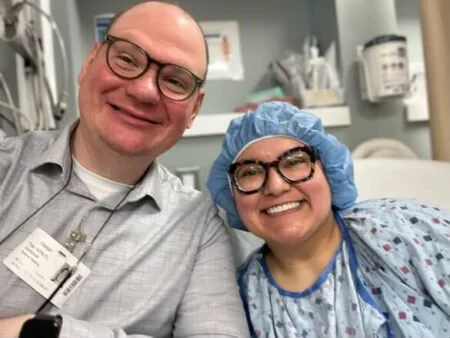
DIANA:
“Access is everything—and it’s not just about finances. Whether you’re in a larger body, a same-sex relationship, or live in a rural area, there are too many barriers to care in this country. And the financial burden is massive. Most people require multiple rounds. Infertility should be treated as healthcare—because it is. Access is everything—and it’s not just about finances. Whether you’re in a larger body, a same-sex relationship, or live in a rural area, there are too many barriers to care in this country. And the financial burden is massive. Most people require multiple rounds. Infertility should be treated as healthcare—because it is.
We’ve had to get creative. We travel for care and pet-sit in exchange for a place to stay while we seek treatment. Right now we’re in Harlem in a beautiful apartment watching an adorable dog while the owners are away, and we’re getting treatment in New York. We couldn’t afford to rent a place for months otherwise. It shouldn’t be this hard, but this is our healthcare system.
PAUL:
“You have to be proactive and persistent. Sadly, a lot of people in similar positions and friends we’ve met along the way never pursued treatment because of these kinds of obstacles. We’ve met many people who’ve gone to extreme lengths to afford care. Friends with PhDs working in warehouses just long enough to get fertility benefits, or paying for COBRA after leaving a job. It’s heartbreaking.”
Access And Equity In Fertility Care: Who Is Left Out?
Delayed or denied care due to financial hardship can have a lasting impact on the success of family building, as well an emotional toll for intended parents. We’ve heard so many patient stories at pregnantish who had to wait years—sometimes too long—because they simply couldn’t afford treatment. We hear from many at pregnantish: “I wasn’t infertile—I was underinsured.” Until equitable access is addressed, the dream of parenthood will remain out of reach for too many.
It’s critical to shine a light on these disparities and push for broader, more inclusive policies. In many parts of the U.S. and around the world, fertility care isn’t considered essential and lacks universal insurance coverage, creating deep regional and national gaps in access.
Racial disparities further compound this issue. Black, Indigenous, and other people of color often face lower success rates with ART, less access to care, and fewer referrals to fertility specialists, even though these communities often have higher rates of conditions like fibroids, endometriosis, PCOS and other conditions that can impact fertility.
LGBTQ+ individuals also face unique financial and legal hurdles when building families, frequently needing to pay out-of-pocket for services like donor sperm, reciprocal IVF, legal counsel for intended parentage, or surrogacy that are rarely covered by insurance.
We hear from many at pregnantish: “I wasn’t infertile—I was underinsured.” Until equitable access is addressed, the dream of parenthood will remain out of reach for too many.
Making Parenthood Within Reach Through LendingClub’s Financing Options
If you can’t afford treatments like IVF, thankfully we are in an era in which financing options are available.
We sat down with Gretchen Addock, Head of Business Development and Sales at LendingClub, to unpack the financial support opportunities readily available for infertility and ART patients.
She shares:
“I’ve always been passionate about access to care. My number one priority is ensuring that clinicians and partners recognize how LendingClub makes it easier for patients to say ‘yes’ to life-changing treatments. I focus on helping providers educate patients and show that affordability doesn’t have to be a barrier to care.”
What Does LendingClub’s Process Look Like?
LendingClub’s process is simple and approachable. Whether online or in a clinic, you can apply by providing basic information—name, address, social security number, and monthly income– and within less than a minute, you are told which plans you qualify for, with no impact on your credit score. Patients often have to pay multiple providers—labs, pharmacies, egg banks—and we allow them to bundle up to four providers into one simple monthly payment. That’s a huge relief during an already stressful time.
Addock continues, “What sets LendingClub apart in the fertility space is multi-faceted:
1) We consider the applicant’s full credit profile—not just their FICO score.
2) Our loan options start as low as 3.99% APR and go up to 84 months, with amounts up to $50,000.
3) Because LendingClub is a bank, we can take a more comprehensive view of someone’s financial situation and offer options tailored to them.
4) Patients often have to pay multiple providers—labs, pharmacies, egg banks—and we allow them to bundle up to four providers into one simple monthly payment. That’s a huge relief during an already stressful time.
5) There are no hidden fees or origination costs. Some competitors charge fees whether you’re approved or not, or have confusing terms. Our process is transparent, safe, and designed to take the guesswork out of financing.”
LendingClub aims to raise awareness about financial options and reach more patients navigating infertility.
“Our goal is to let people know they have financial options—and to walk alongside them in their journey. LendingClub doesn’t just support infertility treatment; we’re here for life’s major milestones. Whether it’s personal loans for college, weddings, home improvement (like preparing a nursery), or saving for the future with high-yield savings accounts, we’re here as a trusted financial partner.
I’m often asked why we don’t approve everyone. The answer is simple: because we care about responsible lending. If we offer someone credit, we want them to feel confident they can manage it—and we want to offer them the best terms for where they are today. We’re not in the business of overextending people—we’re here to support their long-term well-being. Because we’re a responsible lender, we only approve applicants we believe can succeed with repayment.”
The Importance of Advocacy & Where We’re Headed
Despite the growing recognition of infertility as a disease, many still face access issues – financial, geographic, and systemic obstacles to receiving timely and appropriate treatment. Advocacy organizations like RESOLVE, and the American Society for Reproductive Medicine (ASRM) have been instrumental in pushing for legislative and insurance reform to expand coverage and reduce stigma.
Sara Mooney, Practice Administrator, IVI RMA North America has spent 15+ years observing trends in the industry around financial awareness and access to care. She explains:
“Infertility treatment is not only emotionally taxing — it’s expensive and often complicated to navigate. Understanding what insurance covers (and what it doesn’t) can be overwhelming, and patients are frequently left paying large sums out of pocket. A single cycle can range anywhere from $10,000 to upwards of $40,000–$50,000 — what happens if you need two or three? Understanding what insurance covers (and what it doesn’t) can be overwhelming, and patients are frequently left paying large sums out of pocket… That’s why partners like LendingClub are valuable. They help remove a major barrier by offering straightforward, affordable financing options with low interest rates — a contrast to maxed-out credit cards or convoluted loan processes.
That’s why partners like LendingClub are valuable. They help remove a major barrier by offering straightforward, affordable financing options with low interest rates — a contrast to maxed-out credit cards or convoluted loan processes. Even patients with insurance often face significant co-pays, and LendingClub can help fill those financial gaps, whether small or large. I often hear patients express how much relief they feel after using a financial partner like LendingClub – suddenly, their financial limitations aren’t a barrier to building their family, and they can shift their focus back to what really matters: trying to achieve a healthy pregnancy.
I’ve been in this field for over 15 years, and I’ve seen access to care improve in many ways. Clinics have become more creative and proactive in supporting patients, whether through expanding their teams, using technology more effectively, or fully utilizing Advanced Practice Providers (APPs) like nurse practitioners and physician assistants. These skilled providers are instrumental in guiding new patients and supporting treatment alongside physicians.
As someone who went through infertility treatment myself 15 years ago, I can tell you firsthand how much more streamlined and advanced the process has become. And yet still, financial barriers remain. That’s why advocacy is so critical.”
Building A More Equitable Future
While medical advancements in ART have made parenthood more attainable than ever, the reality remains: the financial barriers to fertility care are still far too high for too many.
Companies like LendingClub are helping fill critical gaps by offering transparent, accessible financing options—giving intended parents the opportunity to say “yes” to treatment they may have otherwise had to delay or forgo entirely. For many patients, financial creativity, persistence, and support from financial platforms can turn an overwhelming process into a more hopeful path forward.
Still, meaningful change requires systemic solutions, as too many are still falling through the cracks. As we celebrate progress and look ahead, it’s clear that employers and policymakers play a critical role in improving access—by mandating insurance coverage, supporting inclusive benefits, and ensuring that fertility care is recognized as essential healthcare. With growing awareness and advocacy, a more equitable future is within reach.