

Presented by Juniper Genomics
Every year, there are about 1 million people who report pregnancy loss in the United States. Globally, that number is estimated to be as high as 23 million.
We’ve all heard the stories – or maybe it’s even happened to you. You genetically tested your embryos upon the suggestion of your clinic or community, only to be faced with the upsetting reality that it’s not a guarantee, and you fell into the statistic of intended parents with a failed transfer of a genetically-tested embryo.
While there is never a guarantee with any step in this journey of trying to conceive, especially via Assisted Reproductive Technology (ART), there is some new promising innovation on the horizon.
Recent genetic testing has changed the game for embryo selection, with the aim of drastically improving chances of success for a patient’s first embryo transfer.
What is the latest research on genetics and ART? And where are we headed?
What is PGT and How Does It Work?
The aim of pre-implantation genetic testing (PGT) in IVF is to improve success rates, reduce the risk of pregnancy loss, decrease the incidence of genetic disorders, and ideally reduce the time and resources needed to achieve a healthy pregnancy.
PGT was first used by Handyside et al in the United Kingdom in 1990 to determine the sex of embryos. It was utilized in patients with X-chromosome-linked recessive diseases, to avoid transmission of disease (Reproductive Medicine and Biology, 2020).
Since it was first introduced as a step during the IVF process, PGT has become a routine method for examining embryo aneuploidy and genetic disorders worldwide. For example, for individuals or couples with serious inherited disorders (e.g., if someone has a hereditary neurodegenerative disorder like Huntington’s disease), testing embryos prior to transferring to the uterus can enhance options during the embryo selection process, and therefore decreases the risk of passing on the same diseases.
PGT involves the use of the micromanipulator – a highly specialized instrument used to perform delicate procedures under a microscope – to remove a single or small number of cells from an embryo. This cell is then sent to a lab to determine the genetic competency, and provide patients and their providers with enhanced information about the probability of having a successful transfer, or minimizing the odds of having a child affected with a genetic condition.
According to Fertility and Sterility, the success rate of PGT-A has barely changed since at least 2016. In 2022, only 54.9% of tested embryos resulted in a live birth, barely up from 54.8%.
Recent Advances in PGT Technology
Currently, over half of early pregnancy losses are attributed to chromosomal aneuploidy.
To fill this gap, Juniper Genomics has recently launched a groundbreaking platform for embryo screening: the world’s first test that combines whole genome and transcriptome sequencing for use in IVF.
What does this mean? This idea that suffering and (pregnancy) loss is an expected part of the journey to have a baby is completely unacceptable, especially when we now have the data to avoid it.
In short: Juniper offers a comprehensive genetic test that enhances the embryo selection process, and can lead to a shorter journey to achieving a healthy pregnancy. This is the next generation of PGT.
Dr. Meera Shah, double-board certified OBGYN and Reproductive Endocrinologist at Nova IVF, explains, “The last 10 years, we’ve been stuck in our progress with changing success rates of IVF. When we do a transfer, success rates are 60-70% at best. This means that 30-40% result in failed transfers. Some of the hardest conversations I have in my job are talking to those patients, and watching them go through another stressful treatment cycle that fails. So I’m often left with more questions than answers. And I say ‘let’s try again and hopefully it’ll work.’ We do know that cumulative success rates for IVF are upwards of 95%, but again, seeing my patients having to do a second or third transfer is so hard. It takes time, money, and such an emotional toll.”
During her training, Dr. Shah focused her research in genetics and pregnancy loss, so when she connected with Juniper, she got excited. “The current standard in PGT includes sampling little regions of the chromosome, which means we leave big pieces out when making an extrapolation to determine if the embryo is normal or not. When I connected with the Juniper team, I was excited about the prospect of narrowing the gap of failures, and being able to give my patients more information (they are hungry for it!). I believe that the future of the field, and the ability to improve patient outcomes, is in genetics. So the idea of being able to test for thousands of genetic diseases, test the whole genome, and be able to look for variants prior to implantation failures – it’s all very exciting.”
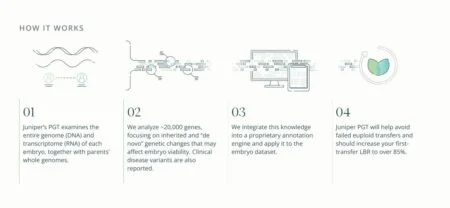
Juniper’s platform analyzes millions of genetic variants across more than 20,000 genes. By integrating a trio analysis — using genetic information from 1) the embryo itself, 2) the sperm contributor, and 3) the egg contributor — Juniper provides complete and clinically relevant insights into embryo health and viability.
This single comprehensive test could replace almost all existing forms of preimplantation genetic testing and offer unprecedented clarity on genetic factors linked to IVF failure, pregnancy loss, and post-birth medical conditions.
The Problem With How We Currently Evaluate Embryos
So what is it about the current standard of PGT that lends itself to inconsistent results?
One of the most common types of testing is preimplantation genetic testing for aneuploidy (PGT-A). Overall, PGT-A can offer numerous benefits during the IVF process, including improved selection of embryos with a higher chance of implantation.
However, studies show that PGT-A often produces inconsistent results, most likely caused by using error-prone lab processes and low-resolution genomics to assess complex chromosome changes (ASRM, 2023).
PGT-A relies on the ability of a single biopsy of 3–10 cells to represent the chromosomal composition of the entire embryo. If the biopsied cells do not represent the entire embryo or if the test itself is inaccurate, then PGT-A could lead to the disposal of healthy embryos.
Laboratories also use different detection methods and thresholds for reporting PGT-A schemes for mosaicism. For example, some labs have recently relied on polygenic risk scores (PRSs) – a tool that aims to measure the health and viability of an embryo.
PRSs can be used to assess the risk of developing diseases by analyzing parts of the embryo’s DNA. This involves calculating the PRS of each embryo based on its DNA and the effects of many small genetic variations associated with a particular disease, and potentially selecting embryos with lower risk profiles. Common diseases PRS look at include diabetes, heart disease, or certain cancers.
The use of PRSs is controversial. According to The Journal of Medical Ethics, the technology is relatively new, and there are current debates about its accuracy. Dr. Shah shares, “Polygenic risk scores are a little in the gray space. There are so many other factors at play in the development of a disease that is multifactorial or polygenic, such as environmental or lifestyle influences that are not claimed in the research, so the accuracy is questionable. The data for polygenic risk scores hasn’t been validated. A big issue with PRSs is also the data used to create the risk profiles are only pulling from European ancestry. We know our patients are diverse and are not all related to European ancestry – this excludes a huge portion of the population of intended parents.”
What Juniper Genomics Does Differently
Juniper’s method avoids controversial polygenic risk scores, which rely on statistical associations rather than concrete predictive power for individual embryos. Instead, the platform focuses on detecting specific genetic changes known to cause adverse outcomes, which can lead to more accurate embryo selection and higher chances of successful pregnancies.
Jeremy Grushcow, PhD, JD, Juniper Genomics CEO and Founder, started his career in the lab when history was made and the human genome was just being sequenced. “When the human genome was sequenced, that early sense of the potential always stuck with me. As I progressed in my career, I kept thinking that we’ll change the future of families if we can just combine the technology we have to create embryos with the information we have about the human genome.
After talking with IVF clinics, I quickly realized that the data given to IVF patients is the minimum data of any genetics encounter, at a time when it’s most impactful – choosing an embryo. I learned that we’re not doing for patients what we could be doing for them to help pick successful embryos. This idea that suffering and (pregnancy) loss is an expected part of the journey to have a baby is completely unacceptable, especially when we now have the data to avoid it.”
Why The Genetics of Your Embryos Matter
Unlike standard PGT, Juniper’s test avoids mislabeling healthy embryos, and finds disease-causing variants that standard tests miss — ultimately aiming to improve live birth rates and reduce pregnancy loss.
Over 95% of patients will succeed if enough euploid embryos are available. The key is understanding that there’s a lot more to clinical genomics than chromosomes. Studies in Nature Medicine show over half of all pregnancy loss is due to inherited and new (i.e., uninherited from biological parents) genetic changes associated with embryo development and viability, in fetuses without chromosome abnormalities. Juniper detects specific genetic changes in 50% of chromosomally euploid (normal) embryos that can cause IVF failure or genetic disease, helping clinicians choose embryos with the highest chance of success.
While other platforms that look at the genome only report on a panel of 5-10% of the genes in the genome, Juniper analyzes millions of variants in every embryo across the entire genome (over 20,000 genes). Unlike standard PGT, Juniper’s test avoids mislabeling healthy embryos, and finds disease-causing variants that standard tests miss — ultimately aiming to improve live birth rates and reduce pregnancy loss.
Grushcow shares, “The main thing I want patients to know is that when a pregnancy or transfer doesn’t succeed, it’s not their fault. It’s almost certainly not the labs fault, nor their doctors – that is very rare. Almost every time, it’s just that the embryo was never capable of making it through all the complex steps required to progress from an egg to a baby. We’re filling the gap with actual data to give people answers about why embryos that are PGTA-normal still don’t succeed half the time, because we know they’re genetic reasons. We want to help you succeed the first time you transfer an embryo.”
When It Comes To IVF, There Are No Guarantees, But Juniper May Help
While advances like Juniper Genomics’ next-generation PGT hold immense promise in improving IVF success rates and offering deeper insight into embryo viability, it’s critical to remember that no test can guarantee a healthy baby.
Even the most comprehensive genetic screenings cannot detect all potential abnormalities or predict every outcome.
Additionally, new technologies can be cost-prohibitive and may not be accessible to all patients, though numerous companies – including Juniper – are working hard to lower the cost of technology, and increase access to care for all patients.
Ultimately, decisions around genetic testing and embryo selection should be highly personalized, made in close consultation with trusted medical professionals who understand each patient’s unique circumstances, values, and goals. As always, staying informed, asking questions, and advocating for your own reproductive health are essential steps on this journey.
As science and technology continues to evolve, being empowered with your options and having the opportunity to choose the right next step for you will remain at the heart of achieving the best possible outcomes.

This article is presented by Juniper Genomics, a health-tech company creating a new standard of care in IVF with the first embryo screening test to combine whole genome and transcriptome sequencing. Juniper delivers the most complete, clinically relevant insights into embryo viability and genetic disorders—helping families and clinicians make more informed decisions and increasing the chances of success with the very first embryo transfer. Learn more at junipergenomics.com or contact info@junipergenomics.com.